Which Petaluma Wetland to Walk This Winter Depends on the Rain and on Jan. 14
November 12, 2026
November 12, 2026
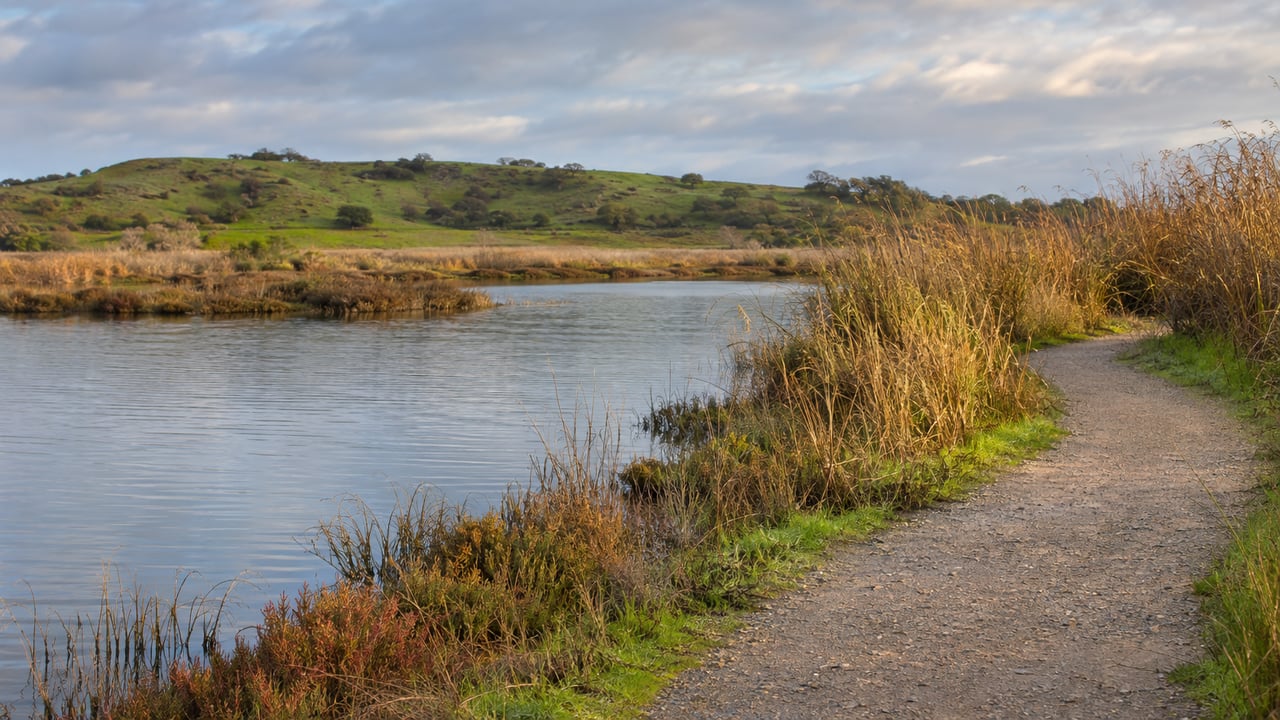
Near the bend in the Shollenberger Park path, close to Adobe Creek, a tall green bat house stands in a cluster of redwoods. In a post published Nov. 3, Petaluma Wetlands Alliance writer Sheryl Nadeau wrote that she went looking for signs of bats there. She found almost none. What she found under the trees were round pellets about the size of a quail egg. She traced them to a pair of White-tailed Kites that nested in those redwoods last spring. One pellet held the skull of a Salt Marsh Harvest Mouse.
Her account is a good reminder that the most-walked trail in southeast Petaluma still turns up surprises. But Shollenberger is only one of two wetlands at that end of town. From now until mid-January, the conditions that make each one worth a visit are moving in different directions. Your best Saturday walk depends on two things. Has it rained enough to fill Shollenberger's pond? And is the calendar still before Jan. 15?
Shollenberger was built to hold river mud. The Petaluma Wetlands Alliance says the city bought the 165-acre ranch along the river around 1970 as a place to dump mud dredged from the Petaluma River. A levee was built around about 80 acres to hold it. The site stayed closed to the public for more than 20 years. It became a city park in the mid-1990s, and the alliance says several hundred people now visit every day.
That history explains how the park works in winter. The alliance notes that most of Shollenberger's water comes from rainfall. On its bird walks page, the group says that once the winter rains return, at least 20 species are common at the Central Pond, including egrets, herons, shorebirds and raptors, and sometimes a bald eagle. Those conditions depend on rain. A dry stretch in late fall means a quieter pond.
The basics stay the same all year:
The other wetland sits just southeast of Shollenberger at the Ellis Creek Water Recycling Facility, 3890 Cypress Drive. Here, too, function came first. According to the alliance, the plant opened to the public in July 2009. Part of its 270-acre site is 30 acres of polishing wetlands, ponds that give treated water a final cleanup. Those engineered ponds hold water whether or not it has rained. The alliance lists them as a year-round birding spot. The seasonal wetlands between the restroom and the polishing ponds are at their best in winter and spring.
That is why the bird walks page suggests Ellis Creek when rain has been scarce at Shollenberger, since Ellis Creek "has water most of the year." In a dry early winter, the plant's ponds are the more reliable place to see birds.
To get there, enter from the east end of Cypress Drive. The alliance describes a parking lot and public restroom just inside the gate. It says the grounds are open dawn to dusk and the rules match Shollenberger's, so dogs stay leashed here too. Areas with sewage-processing equipment are off-limits. More than three miles of trails wind through the rest. A 0.3-mile trail connects Shollenberger's southeast corner to the Ellis Creek trails, so you can walk both sites in one outing. The alliance does warn that this connector may flood in winter.
The calendar matters most at Ellis Creek. The facility includes more than 100 acres of brackish tidal wetland that connects to the Petaluma River at high tide. The alliance says the Tidal Marsh Trail is open for birding from Sept. 1 to Jan. 14. From Jan. 15 through Aug. 31, the tidal wetland is closed to the public to protect nesting California Clapper Rails, an endangered species.
From mid-November, that leaves about two months. After Jan. 14, you can still look across the tidal marsh from the Shollenberger loop to the north. Walking the trail itself has to wait until September.
If you have only one free Saturday morning before the holidays, it makes sense to spend it on the trail that closes soon.
The alliance runs free docent-led bird and nature walks from October through June, 9 to 11 a.m. Walks are on the second Saturday of the month at Shollenberger and the fourth Saturday at Ellis Creek Trails. Meet in each site's parking lot. No reservations are needed. Each walk covers about a mile, and you're welcome to keep going on the full loop afterward.
On that schedule, the next walks fall on these dates:
| Saturday | Site | Note |
|---|---|---|
| Nov. 28 | Ellis Creek Trails | Tidal Marsh Trail open for birding |
| Dec. 12 | Shollenberger Park | Pond conditions depend on rainfall |
| Dec. 26 | Ellis Creek Trails | Last fourth-Saturday walk before the tidal trail closes |
| Jan. 9 | Shollenberger Park | Five days before the Jan. 14 cutoff |
| Jan. 23 | Ellis Creek Trails | Tidal wetland closed for nesting season |
Walks are canceled for rain, nearby fires or dangerous air quality. The storms that fill Shollenberger's pond can also cancel the walk scheduled to see it. The best Shollenberger mornings may come on dry days soon after a wet week. The alliance suggests bringing binoculars, water, a hat and layers, because mornings that start foggy and cold often warm up quickly.
The alliance's Winter Wonders at Shollenberger feature lists winter birds to watch for. It includes American Avocets, Black-necked Stilts, Black-crowned Night Herons, Northern Harriers, Peregrine Falcons, Red-tailed Hawks, sandpipers, dowitchers and the occasional Bald Eagle. The feature dates to 2024, so read it as a guide to the season, not a count from this year.
For more recent numbers, the alliance launched its Bird Survey Explorer on July 30, 2026. It lets you filter survey data by date range and by wetland, summarize counts and species, browse species profiles, and download the results as a CSV file. The two wetlands aren't equally current in it. The Explorer page lists Ellis Creek data through Sept. 23, 2026, and Shollenberger data through April 2026. For a recent baseline before a walk, Ellis Creek has the fresher numbers too.
The Petaluma Voice reported in April on a long-range restoration vision from the San Francisco Estuary Institute. It covers Shollenberger, Alman Marsh and Gray's Marsh, three city-owned wetlands covering nearly 500 acres. The near-term phase would focus on Alman and Gray's marshes. A later phase, in the second half of the century, would remove most of Shollenberger's levee and the 2.15-mile loop trail on top of it. The inland gravel path to Ellis Creek would stay. Boardwalks would cross the restored marsh to a new fishing pier on the river, but they would not run along the riverfront the way the loop does now.
The outlet stressed that this is one vision, not an adopted plan. In the Petaluma Voice report, Petaluma's director of water resources and utilities said the city would first need a feasibility study estimated at about $3 million. The Army Corps of Engineers turned down the city's first request to fund it. The city is now looking at the Corps' 2028 budget and at Proposition 4, the state bond voters passed in November 2024. In the same article, Friends of the Petaluma River executive director Stephanie Bastianon said of possibly losing the riverfront trail, "It's something that we have to weigh as a community." This winter, the levee-top loop is open as usual.
If you'd like to lead walks yourself, the alliance's 2027 volunteer training runs on five Thursday mornings: Jan. 7, 14, 21 and 28, and Feb. 4, from 9 a.m. to noon at Lucchesi Community Center, 320 N. McDowell Boulevard.
Living near Shollenberger and Ellis Creek means these winter mornings are a short drive or walk away. If you're thinking about where you want to live in Petaluma next, or about the home you have now, I'm happy to help. Visit Ashley McSweeney to request a free home valuation and consultation.
Stay up to date on the latest real estate trends.
Get assistance in determining current property value, crafting a competitive offer, writing and negotiating a contract, and much more. Contact me today.